Blog

Blend4Web: Beginner's Guide. Chapter 3. Moving Vertices

2016-11-07

In the previous lesson you created your first model, or, more precisely, a template with a form that resembles a smartphone. There is still a lot of work until this project is complete, but there is nothing to be afraid of. In the third lesson you will get to know new tools and simple and efficient modeling methods. In general, half an hour will suffice in order to become confident with the new material.

For convenience, I've attached a work-in-progress scene with the smartphone template to this lesson (link below). But, of course, you can use any of your previous projects instead. And I am sure the results of yours will be even better than mine!

Editing Basics

You have already learned how to change the form of an object by changing its scale. In reality, though, this is a very rough way to form a model. In essence, only a basic shape can be created this way. The real power is manifested only when you manipulate the elements of an object.

A three-dimensional model is made of vertices connected with edges and polygon planes. All of these can be accessed through a special working mode of the 3D View window appropriately known as Edit Mode. It can be selected in the Mode menu (fig. 1).

Figure 1

Remember one simple rule: the Mode menu concerns only an active (selected) object in a scene. You gain exclusive access to modify it. And until you exit Edit Mode, all other objects are unavailable.

We are interested in two modes: Object Mode and Edit Mode. The first one is selected by default. It is a mode which allows us to manipulate objects in the scene: move them to specific places, rotate them and so on. However, if you want to edit a particular object, you have to switch to Edit Mode.

Figure 2

If you've already done it, you'll notice that the appearance of the model has changed a little. This is how the program shows the structure of the object (look at the fig. 2). We can see the vertices and edges connecting them, "filled" by polygons. So, you can manipulate any of these elements, and not necessarily just one at a time. Moreover, all manipulations are performed the way you're already familiar with. You just need to select all those elements beforehand. Blender allows you to set up current selection mode: vertices, edges or faces. This option is available in the Select panel of the 3D View window (look at the fig. 2). I've marked the buttons you will need in the picture. The first of them is responsible for vertices, the second for edges, and the last one for polygons, respectively. Try, for example, to select any vertex and to move it with the mouse. It's easy!

That's exactly how modeling is done. You select elements you need and manipulate them. You can change the scale, move or rotate them. To select several elements simultaneously, you need to use the Shift key.

To work faster and more conveniently, I recommend memorizing the following hot keys:

 The G button enables Translate (grab/move) mode

 The R button handles rotations

 The S button allows you to change the scale.

At the moment, our model is perfectly smooth on every side, but it's not realistic. We need buttons, cameras, various decorative stamps and the screen. It is better to create some elements of a smartphone as separate objects, e.g smartphone buttons. But the screen should be an essential part of the model.

Let's assume that we have to leave some free space for a camera and control buttons at the top and the bottom of the device, and the screen should be pushed a little inside compared to the rest of the frame. But how can we do this, if we only have 8 vertices?

At first, we have to apply the Bevel modifier that we used in the previous lesson to, well, bevel the object's edges. You most likely remember that modifiers change the structure of an object "on the fly". That means new elements will also be modified, which we don't need. Switch to Object Mode, open the modifier tab and press the Apply button.

There are many ways to add elements to an object's structure. In our case, the tool called Loop Cut And Slide will do. It is intended for creating additional edges in circles. Let's see how it works.

Switch to Edit Mode and put the mouse cursor at the center of the model. Press the CTRL+R hot key to quickly activate the instrument. Try moving the mouse within the boundaries of the object, and you will see pink perimeters around the object. And by rotating the mouse wheel, you can create several of these edges (fig. 3).

Figure 3

This is how this instrument shows where the edges will initially be set. But, in reality, nothing is done yet. If you press the Esc key, the program will simply disable the tool. By pressing the left mouse button, you can confirm your choice. But this is not the end step either.

The instrument will create new edges at the place you have chosen; it will mark them orange, but it will not save the result. You can move these edges anywhere by simply moving your mouse. And just clicking the left button a second time will mark the end of the work.

This is how I created additional edges seen in the Figure 4.

Figure 4

Let's conduct a little experiment.

Enable polygon selection mode, mark where you want your screen to be and try to move it inwards (into the phone). But what's this? You're left with some backward-curved frame that clearly won't do (fig. 5).

Figure 5

You probably have already guessed the reason for this — there are not enough elements once again. But please don't rush to use the Loop Cut And Slide tool, there is a better solution.

Blender has a very convenient Extrude instrument. Its purpose is to emboss, to fully copy a selected part of the object without breaking connections. Imagine yourself selecting a polygon, pressing the E key and you get your screen. Better yet, don't imagine it — let's do it!

The Extrude instrument works in a way similar to that of Loop Cut and Slide. After activating it, the program will create the necessary elements but will not yet finish the operation. You can move new polygons anywhere you want. Just a click of the left mouse button will set the results in place.

Do this, and you will get a result similar to the one shown in the picture below.

Figure 6

Now you are familiar with the most common method of quick modeling. To help you memorize this method, I've separated it into these steps:

1. Creating the base form from a simple shape.

2. Editing the structure of the object with transform tools.

3. Using the Extrude tool to add new elements and Loop Cut And Slide to subdivide existing ones.

Nuances in the Work

Buttons, cameras, panels — there are still numerous things that we have to add to our smartphone. I won't limit your creativity, so enhance your device with any additions you would like. But let us take a look at several more of the convenient modeling tools the program has to offer.

You can always emboss new elements in the frame with the Extrude tool. However, in some cases it is much more convenient to add new, separate objects, for animation purposes, for example.

Upon startup, the program has already prepared one basic shape that you used to create the frame of the smartphone. But you can always add an unlimited number of other shapes, various forms and complexity to the scene. You can also add new light sources, additional cameras and much more.

In the 3D View window menu, there is an entry appropriately called Add. Select it, and a palette of various objects will unfold before you. For want of a habit, you can even get lost in it (fig. 7).
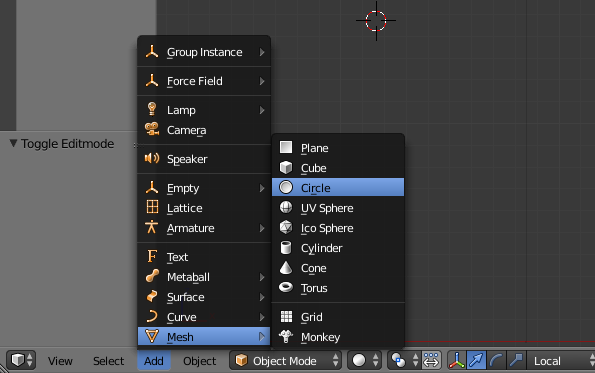
Figure 7

Look closely at the picture. Do you recognize a "target scope" that you're already familiar with? It can be moved in the 3D View window by clicking the left mouse button. This is a very important additional tool for creating a scene. First of all, the 3D Cursor (let's call it that) marks the place where new objects will be added to the scene. It works flawlessly in every window mode, but now we need Object Mode. Enable it.

We are working with Mesh group shapes. They have simple and convenient structures and are perfectly suited for achieving our goals. Figure 7 shows all available Mesh objects. For example, we used a Cube to create the frame, but Circle will be more suitable to create the camera's eye-lens.

Switch to Front View mode (NumPad 1 hot key) and enable orthographic view (NumPad 5 key). This mode is convenient in a way that perspective distortions are not visible.

Place the 3D cursor in any free spot. Select Circle shape from the Add | Mesh menu, and it will immediately appear in the place you indicated.

Remember the following rule: Blender allows you to change the settings of a new shape only directly after it has been created. If you, say, try to move it, the settings will disappear. However, these settings are very important for our task. Look at the left panel of the 3D View window. It usually contains tools for the current mode, however, when creating a new object, parameters of that object appear at the bottom of it (fig. 8).

Figure 8

It is entirely possible that the newly created Circle is pointed in a wrong direction, so check the Align to View box. This shape has 32 vertices by default, and that's too many. You can change the number of vertices in the Vertices field. And the Fill Type menu allows us, of course, to choose the fill type.

At first, the Circle has no volume. It can be added using the Extrude tool. Switch to the Edit mode (Tab hot key), select all elements (the A key) and press E to extrude the volume. To add depth, switch to the vertex selection mode and move the central point a bit deeper. All in all, here's what I've got (fig. 9).
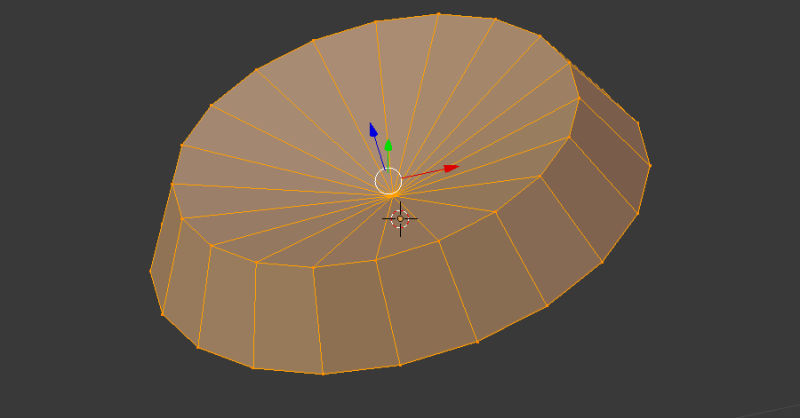
Figure 9

As you can see, creating separate parts of a model does not pose any difficulties. All you have to do is select a fitting shape and "polish" it with the Extrude tool. Let's take a look at some additional instruments that we might need during editing.

Delete. You can delete either single or multiple elements. Select the ones you need, press the X hot key, and the program will show a corresponding menu where you can select, what you specifically want to delete. By the way, this hot key works in Object Mode as well, however, it will delete the whole object.

Polygon fill. You can "stretch" a polygon between several vertices, if you select them and press the F button.

Duplicating. Unlike the Extrude tool, duplicating allows you to create a separate copy of whatever you have selected, both in Edit and in Object modes. For example, you can make a button object and copy it as many times as you need. This is done by using the Shift+D hot keys.

We have examined basic modeling in Blender. By using only a handful of tools you can create an object of almost any complexity. Of course, features of the program do not end here. Now I will move to another very interesting style of modeling and while I'm thinking of the next paragraph, you can fine-tune small details on your device.

Symmetrical Modeling

Left and right, right and left — symmetry is all around us. It would be silly to model two identical parts of an object separately. For example, it's easier to create one character's hand and then use its mirror image. And, there is a developed mechanism for this kind of modeling, with the "reflection" automatically being created.

Usually, a cube shape is used for symmetrical modeling, but you can just as well choose a different object from the Mesh group. However, I would still advise you to use a cube.

Before starting your work, you will need to prepare your shape the following way:

Add a cube to the scene and switch to the Front (NumPad 1) view mode. In the Edit Mode, you have to slice it into two halves vertically using the Loop Cut And Slide tool. Delete all vertices on the left side of the object. You should get what is shown in the picture below.

Figure 10

All these steps are determined not by my whim but by a pattern developed by many artists. You edit the right side of the object using the tools you are already familiar with, while the program automatically builds the left side. And the Mirror modifier will help us with this.

Add it to the object, and you will see the following (fig. 11).

Figure 11

Now you can boldly edit the visible half of the object. Try to extrude one of the polygons, move, rotate and scale it. The program will imitate all your actions with ease. This way, for example, you can create a stand for your smartphone. The Mirror modifier is very often used in modeling, so we better discuss its parameters more thoroughly.

 The Axis option group. This is none else than an instruction for the modifier, which specifies what sides it should process. It is set to the X axis by default. For example, you can remove the bottom half of the shape and check the Z box. Then, this coordinate will also be used for doubling.

 The Clipping option. It prohibits translation of the object center by moving the vertices. It can be used to be sure you won't ruin your object.

 The Merge option. It automatically combines the vertices that are placed within the range set in the Merge Limit field.

And that's all for now. The knowledge you have acquired should be enough to make a scene like mine (fig. 12). You didn't think that I would describe every single step of creating it, did you?

I believe that you can make a much better model than mine. Go for it, but don't get comfortable just yet! We still have many interesting things ahead of us.

Figure 12


Comments
03 nov. 2025 22:25
Ahmedabad, the city of culture, business, and vibrant energy, is also home to moments of sophistication and quiet indulgence. For those who appreciate class, comfort, and confidence, the world of Call girls Ahmedabadlink brings you the most refined and discreet companionship experiences available today.
03 nov. 2025 22:28
Ahmedabad, the city of culture, business, and vibrant energy, is also home to moments of sophistication and quiet indulgence. For those who appreciate class, comfort, and confidence, the world of Call girls Ahmedabad brings you the most refined and discreet companionship experiences available today.
04 nov. 2025 13:40
The journey toward becoming a competent and influential nurse leader involves a profound understanding of healthcare systems, organizational leadership, ethical decision-making, and professional collaboration. In the academic setting, the Capella University course NURS FPX 8008 plays a critical role in shaping nurses into effective leaders who can address challenges, inspire teams, and improve patient outcomes. The course emphasizes leadership theories, interprofessional collaboration, communication strategies, and the development of change initiatives that transform healthcare practice. Understanding NURS FPX 8008 Assessment 2, Assessment 3, and Assessment 4 is essential for students who aim to excel academically and professionally. Each assessment represents a milestone in applying theoretical knowledge to real-world nursing leadership scenarios, requiring critical thinking, evidence-based reasoning, and strategic planning.

NURS FPX 8008 Assessment 2 often focuses on the analysis of leadership theories and their application within healthcare organizations. In this assessment, students are typically asked to identify a specific leadership model that aligns with their personal philosophy or professional practice NURS FPX 8008 Assessment 2 . This is where nurses begin to understand the interplay between leadership style, team performance, and organizational culture. The assessment may involve evaluating transformational leadership, servant leadership, or authentic leadership and explaining how these approaches influence motivation, trust, and collaboration in nursing teams. Transformational leadership, for instance, encourages innovation and inspires nurses to achieve higher performance levels by focusing on shared vision and values. Servant leadership emphasizes empathy, humility, and service to others, making it ideal for patient-centered care environments. Authentic leadership, on the other hand, promotes transparency and self-awareness, ensuring ethical and consistent decision-making. In completing NURS FPX 8008 Assessment 2, students learn how to assess their leadership strengths, identify growth areas, and articulate a vision for leading others effectively. This self-reflection is not just an academic exercise but a foundation for lifelong professional growth.

NURS FPX 8008 Assessment 3 extends the discussion by integrating leadership theories into practical decision-making and organizational challenges. This assessment often involves evaluating leadership strategies in real or hypothetical scenarios, requiring students to analyze complex healthcare problems and propose leadership-driven solutions. It might involve examining case studies where nurse leaders must navigate ethical dilemmas, budget constraints, staffing shortages, or communication barriers. Students must use evidence-based research to support their decisions and demonstrate how effective leadership can mitigate risks, enhance patient safety, and promote organizational success. Through NURS FPX 8008 Assessment 3, nurses refine their analytical skills, learning how to balance compassion with accountability and vision with practicality. The assessment encourages the application of interdisciplinary collaboration by involving perspectives from physicians, administrators, and allied health professionals. This reflects the real-world environment where effective leadership depends on the ability to build relationships, manage conflict, and promote teamwork. By integrating theory with practice, Assessment 3 transforms abstract leadership concepts into actionable strategies that can make a tangible difference in healthcare delivery.

In contrast, NURS FPX 8008 Assessment 4 typically focuses on implementing leadership principles through change management and quality improvement initiatives. This is often the most challenging and rewarding part of the course because it requires students to take a leadership concept or organizational issue and design a practical intervention plan. Whether addressing medication errors, improving patient satisfaction, or enhancing team communication, students must propose sustainable solutions supported by current research and leadership frameworks. The goal is not just to identify problems but to lead change effectively. Change management in nursing is complex because it involves human behavior, institutional culture, and ethical considerations. Students in NURS FPX 8008 Assessment 4 learn to apply models such as Lewin’s Change Theory or Kotter’s 8-Step Process to plan, communicate, and implement transformation within healthcare settings. The assessment emphasizes the role of the nurse leader as a change agent who inspires commitment, addresses resistance, and evaluates outcomes systematically. This reflects the reality that leadership in nursing is not static—it evolves through the continuous process of learning, adapting, and innovating.

Collectively, these three assessments in NURS FPX 8008 represent a progressive journey from understanding leadership concepts to applying them in real-world situations and ultimately leading organizational change. Through Assessment 2, students establish a theoretical foundation by exploring leadership models and personal philosophies. In Assessment 3, they apply those models to analyze practical challenges and demonstrate decision-making competence. Assessment 4 takes it further by emphasizing execution—how to turn ideas into results that improve patient care and organizational efficiency. This sequence mirrors the development process of a nurse leader in practice: learning, applying, and leading. Each assessment builds upon the previous one, ensuring that students not only understand leadership but also embody it in their professional roles.

The NURS FPX 8008 course also cultivates essential soft skills that are crucial in modern healthcare environments. Communication, for example, is a recurring theme across all assessments. Effective communication enables leaders to articulate visions, delegate responsibilities, and foster a culture of openness and respect. Ethical decision-making is another core element, ensuring that nurse leaders uphold professional standards and patient rights even when facing moral ambiguity or institutional pressure. Emotional intelligence, resilience, and cultural competence also play vital roles in managing diverse teams and delivering equitable care. Students learn that leadership is not only about authority but about influence, empathy, and collaboration. A strong leader listens actively, supports team members, and encourages professional growth. These skills transcend academia and prepare nurses for leadership roles in hospitals, clinics, community health organizations, and policy-making institutions.

Moreover, completing NURS FPX 8008 Assessments 2, 3, and 4 helps students understand the broader healthcare context. Leadership today requires awareness of trends such as healthcare technology, interprofessional collaboration, value-based care, and patient safety initiatives NURS FPX 8008 Assessment 3. Assessment tasks often incorporate these elements by asking students to analyze how leaders respond to technological change, regulatory updates, or evolving patient needs. For instance, integrating digital health tools requires leaders who can manage transitions, train staff, and ensure data security. Similarly, addressing nurse burnout requires compassionate leadership and effective resource management. Students are encouraged to research current literature, evaluate policies, and recommend evidence-based interventions. This promotes scholarly thinking and aligns leadership practice with contemporary healthcare challenges.

An integral aspect of NURS FPX 8008 is self-reflection. Throughout the course, students are encouraged to assess their leadership competencies and identify areas for improvement. This reflective process strengthens self-awareness—a hallmark of effective leadership. In Assessment 2, reflection might involve identifying personal leadership style and values. In Assessment 3, it might involve evaluating decision-making processes and conflict resolution skills. In Assessment 4, it becomes about envisioning long-term change and sustainability. By continuously reflecting on their performance, students develop confidence and adaptability, both of which are essential for leading in dynamic healthcare environments. Reflection also fosters lifelong learning—a commitment that defines the nursing profession.

Another critical dimension is ethical leadership. The healthcare industry constantly faces ethical challenges, from resource allocation to patient confidentiality and end-of-life care. NURS FPX 8008 assessments frequently address these issues, requiring students to demonstrate ethical reasoning and moral courage. Nurse leaders must navigate competing interests while maintaining integrity and compassion. Ethical leadership ensures that decisions prioritize patient welfare and uphold professional standards. Students explore how ethical frameworks guide leadership behavior, promote accountability, and enhance organizational trust. Through these assessments, they learn to align personal ethics with professional responsibilities, creating a foundation for credible and principled leadership.

Teamwork and collaboration are equally emphasized throughout the NURS FPX 8008 course. Effective nurse leaders recognize that success depends on collective effort, not individual authority. Assessments often include collaborative components or discussions that encourage students to engage with peers, exchange perspectives, and practice shared decision-making. These experiences prepare nurses to lead interdisciplinary teams in real-world healthcare settings. Collaborative leadership enhances communication, reduces errors, and improves patient satisfaction. It also nurtures a culture of respect and inclusion, where every team member feels valued. Through the process of completing Assessments 2, 3, and 4, students realize that leadership is not about control but about connection—uniting people around a common purpose and shared values.

NURS FPX 8008 also strengthens academic and professional writing skills, which are vital for effective leadership communication. Writing these assessments requires clarity, organization, and evidence-based reasoning. Students must synthesize scholarly sources, apply APA formatting, and present logical arguments. This discipline enhances their ability to communicate persuasively in professional settings, whether writing reports, proposals, or policy briefs. Academic writing promotes critical thinking and precision, qualities that translate directly into effective leadership communication. Through these assignments, students refine their ability to express complex ideas with confidence and authority, ensuring their voices are heard in multidisciplinary discussions and organizational decisions.

Leadership in nursing is not limited to administrative roles; it permeates every level of practice. Staff nurses, educators, and advanced practitioners all exercise leadership in different forms. The NURS FPX 8008 assessments encourage students to view leadership as a mindset rather than a title. Leadership involves taking initiative, advocating for patients, mentoring peers, and fostering continuous improvement. By completing these assessments, nurses develop a deeper appreciation for their capacity to influence outcomes and drive positive change. The knowledge and skills gained from this course prepare them to take on advanced leadership roles or contribute meaningfully within their current positions.

The cumulative impact of NURS FPX 8008 Assessments 2, 3, and 4 extends beyond academic achievement. These experiences shape a professional identity grounded in integrity, empathy, and innovation. Graduates of this course are better equipped to lead change, manage complexity, and inspire others in an ever-evolving healthcare landscape. They understand that leadership is not a one-time achievement but a continuous journey of growth and service. The lessons learned—about self-awareness, ethical conduct, effective communication, and change management—remain relevant throughout their careers. As healthcare continues to evolve, the demand for visionary and compassionate nurse leaders grows stronger. NURS FPX 8008 ensures that graduates are ready to meet this demand with competence and confidence.

In essence, the course and its key assessments serve as a microcosm of real-world leadership practice. Assessment 2 lays the foundation through theoretical exploration, helping students understand what leadership means and how it can be applied in nursing contexts. Assessment 3 tests analytical and decision-making abilities, encouraging students to apply theory to practical, often complex situations. Assessment 4 challenges them to act as change leaders—strategizing, implementing, and evaluating initiatives that make a difference in healthcare outcomes. This structured progression mirrors the journey of leadership development, moving from understanding to application to transformation. Each stage equips students with new perspectives and skills, culminating in a comprehensive understanding of what it takes to be an effective nurse leader.

Ultimately, success in NURS FPX 8008 depends on more than academic effort; it requires passion, reflection, and commitment. Students who approach each assessment with curiosity and openness gain far more than grades—they develop the mindset of lifelong leaders. They learn to view challenges as opportunities, failures as lessons, and teamwork as strength. They come to realize that leadership in nursing is about creating positive change, empowering others, and ensuring quality care for every patient. The insights gained from NURS FPX 8008 Assessments 2, 3, and 4 are not confined to the classroom but echo throughout one’s nursing career, shaping the future of healthcare leadership with compassion, innovation, and excellence.

The culmination of these assessments transforms not only knowledge but also identity NURS FPX 8008 Assessment 4. Nurses emerge as confident leaders capable of influencing systems and inspiring others. The academic rigor and reflective nature of the course foster both intellectual and emotional growth. By integrating leadership theory, ethical reflection, and practical application, NURS FPX 8008 prepares nurses to navigate the complexities of modern healthcare with wisdom and resilience. The course reinforces that leadership is not just a skill—it is a calling rooted in service, integrity, and purpose. Completing Assessments 2, 3, and 4 symbolizes a commitment to this calling, marking the transition from learning about leadership to living it every day.

Through perseverance, reflection, and dedication, nursing students who successfully complete NURS FPX 8008 demonstrate their readiness to lead in diverse healthcare settings. They stand at the forefront of change, guided by knowledge, compassion, and ethical conviction. Their journey through these assessments represents not just academic progress but personal transformation—a testament to the power of leadership education in shaping the future of nursing. NURS FPX 8008 Assessment 2, NURS FPX 8008 Assessment 3, and NURS FPX 8008 Assessment 4 collectively build the foundation for that transformation, inspiring every nurse to lead with courage, wisdom, and heart.
04 nov. 2025 14:12
Reply to post of user EmmaBrown
The journey toward becoming a competent and influential nurse leader involves a profound understanding of healthcare systems, organizational leadership, ethical decision-making, and professional collaboration. In the academic setting, the Capella University course NURS FPX 8008 plays a critical role in shaping nurses into effective leaders who can address challenges, inspire teams, and improve patient outcomes. The course emphasizes leadership theories, interprofessional collaboration, communication strategies, and the development of change initiatives that transform healthcare practice. Understanding NURS FPX 8008 Assessment 2, Assessment 3, and Assessment 4 is essential for students who aim to excel academically and professionally. Each assessment represents a milestone in applying theoretical knowledge to real-world nursing leadership scenarios, requiring critical thinking, evidence-based reasoning, and strategic planning.

NURS FPX 8008 Assessment 2 often focuses on the analysis of leadership theories and their application within healthcare organizations. In this assessment, students are typically asked to identify a specific leadership model that aligns with their personal philosophy or professional practice NURS FPX 8008 Assessment 2 . This is where nurses begin to understand the interplay between leadership style, team performance, and organizational culture. The assessment may involve evaluating transformational leadership, servant leadership, or authentic leadership and explaining how these approaches influence motivation, trust, and collaboration in nursing teams. Transformational leadership, for instance, encourages innovation and inspires nurses to achieve higher performance levels by focusing on shared vision and values. Servant leadership emphasizes empathy, humility, and service to others, making it ideal for patient-centered care environments. Authentic leadership, on the other hand, promotes transparency and self-awareness, ensuring ethical and consistent decision-making. In completing NURS FPX 8008 Assessment 2, students learn how to assess their leadership strengths, identify growth areas, and articulate a vision for leading others effectively. This self-reflection is not just an academic exercise but a foundation for lifelong professional growth.

NURS FPX 8008 Assessment 3 extends the discussion by integrating leadership theories into practical decision-making and organizational challenges. This assessment often involves evaluating leadership strategies in real or hypothetical scenarios, requiring students to analyze complex healthcare problems and propose leadership-driven solutions. It might involve examining case studies where nurse leaders must navigate ethical dilemmas, budget constraints, staffing shortages, or communication barriers. Students must use evidence-based research to support their decisions and demonstrate how effective leadership can mitigate risks, enhance patient safety, and promote organizational success. Through NURS FPX 8008 Assessment 3, nurses refine their analytical skills, learning how to balance compassion with accountability and vision with practicality. The assessment encourages the application of interdisciplinary collaboration by involving perspectives from physicians, administrators, and allied health professionals. This reflects the real-world environment where effective leadership depends on the ability to build relationships, manage conflict, and promote teamwork. By integrating theory with practice, Assessment 3 transforms abstract leadership concepts into actionable strategies that can make a tangible difference in healthcare delivery.

In contrast, NURS FPX 8008 Assessment 4 typically focuses on implementing leadership principles through change management and quality improvement initiatives. This is often the most challenging and rewarding part of the course because it requires students to take a leadership concept or organizational issue and design a practical intervention plan. Whether addressing medication errors, improving patient satisfaction, or enhancing team communication, students must propose sustainable solutions supported by current research and leadership frameworks. The goal is not just to identify problems but to lead change effectively. Change management in nursing is complex because it involves human behavior, institutional culture, and ethical considerations. Students in NURS FPX 8008 Assessment 4 learn to apply models such as Lewin’s Change Theory or Kotter’s 8-Step Process to plan, communicate, and implement transformation within healthcare settings. The assessment emphasizes the role of the nurse leader as a change agent who inspires commitment, addresses resistance, and evaluates outcomes systematically. This reflects the reality that leadership in nursing is not static—it evolves through the continuous process of learning, adapting, and innovating.

Collectively, these three assessments in NURS FPX 8008 represent a progressive journey from understanding leadership concepts to applying them in real-world situations and ultimately leading organizational change. Through Assessment 2, students establish a theoretical foundation by exploring leadership models and personal philosophies. In Assessment 3, they apply those models to analyze practical challenges and demonstrate decision-making competence. Assessment 4 takes it further by emphasizing execution—how to turn ideas into results that improve patient care and organizational efficiency. This sequence mirrors the development process of a nurse leader in practice: learning, applying, and leading. Each assessment builds upon the previous one, ensuring that students not only understand leadership but also embody it in their professional roles.

The NURS FPX 8008 course also cultivates essential soft skills that are crucial in modern healthcare environments. Communication, for example, is a recurring theme across all assessments. Effective communication enables leaders to articulate visions, delegate responsibilities, and foster a culture of openness and respect. Ethical decision-making is another core element, ensuring that nurse leaders uphold professional standards and patient rights even when facing moral ambiguity or institutional pressure. Emotional intelligence, resilience, and cultural competence also play vital roles in managing diverse teams and delivering equitable care. Students learn that leadership is not only about authority but about influence, empathy, and collaboration. A strong leader listens actively, supports team members, and encourages professional growth. These skills transcend academia and prepare nurses for leadership roles in hospitals, clinics, community health organizations, and policy-making institutions.

Moreover, completing NURS FPX 8008 Assessments 2, 3, and 4 helps students understand the broader healthcare context. Leadership today requires awareness of trends such as healthcare technology, interprofessional collaboration, value-based care, and patient safety initiatives NURS FPX 8008 Assessment 3. Assessment tasks often incorporate these elements by asking students to analyze how leaders respond to technological change, regulatory updates, or evolving patient needs. For instance, integrating digital health tools requires leaders who can manage transitions, train staff, and ensure data security. Similarly, addressing nurse burnout requires compassionate leadership and effective resource management. Students are encouraged to research current literature, evaluate policies, and recommend evidence-based interventions. This promotes scholarly thinking and aligns leadership practice with contemporary healthcare challenges.

An integral aspect of NURS FPX 8008 is self-reflection. Throughout the course, students are encouraged to assess their leadership competencies and identify areas for improvement. This reflective process strengthens self-awareness—a hallmark of effective leadership. In Assessment 2, reflection might involve identifying personal leadership style and values. In Assessment 3, it might involve evaluating decision-making processes and conflict resolution skills. In Assessment 4, it becomes about envisioning long-term change and sustainability. By continuously reflecting on their performance, students develop confidence and adaptability, both of which are essential for leading in dynamic healthcare environments. Reflection also fosters lifelong learning—a commitment that defines the nursing profession.

Another critical dimension is ethical leadership. The healthcare industry constantly faces ethical challenges, from resource allocation to patient confidentiality and end-of-life care. NURS FPX 8008 assessments frequently address these issues, requiring students to demonstrate ethical reasoning and moral courage. Nurse leaders must navigate competing interests while maintaining integrity and compassion. Ethical leadership ensures that decisions prioritize patient welfare and uphold professional standards. Students explore how ethical frameworks guide leadership behavior, promote accountability, and enhance organizational trust. Through these assessments, they learn to align personal ethics with professional responsibilities, creating a foundation for credible and principled leadership.

Teamwork and collaboration are equally emphasized throughout the NURS FPX 8008 course. Effective nurse leaders recognize that success depends on collective effort, not individual authority. Assessments often include collaborative components or discussions that encourage students to engage with peers, exchange perspectives, and practice shared decision-making. These experiences prepare nurses to lead interdisciplinary teams in real-world healthcare settings. Collaborative leadership enhances communication, reduces errors, and improves patient satisfaction. It also nurtures a culture of respect and inclusion, where every team member feels valued. Through the process of completing Assessments 2, 3, and 4, students realize that leadership is not about control but about connection—uniting people around a common purpose and shared values.

NURS FPX 8008 also strengthens academic and professional writing skills, which are vital for effective leadership communication. Writing these assessments requires clarity, organization, and evidence-based reasoning. Students must synthesize scholarly sources, apply APA formatting, and present logical arguments. This discipline enhances their ability to communicate persuasively in professional settings, whether writing reports, proposals, or policy briefs. Academic writing promotes critical thinking and precision, qualities that translate directly into effective leadership communication. Through these assignments, students refine their ability to express complex ideas with confidence and authority, ensuring their voices are heard in multidisciplinary discussions and organizational decisions.

Leadership in nursing is not limited to administrative roles; it permeates every level of practice. Staff nurses, educators, and advanced practitioners all exercise leadership in different forms. The NURS FPX 8008 assessments encourage students to view leadership as a mindset rather than a title. Leadership involves taking initiative, advocating for patients, mentoring peers, and fostering continuous improvement. By completing these assessments, nurses develop a deeper appreciation for their capacity to influence outcomes and drive positive change. The knowledge and skills gained from this course prepare them to take on advanced leadership roles or contribute meaningfully within their current positions.

The cumulative impact of NURS FPX 8008 Assessments 2, 3, and 4 extends beyond academic achievement. These experiences shape a professional identity grounded in integrity, empathy, and innovation. Graduates of this course are better equipped to lead change, manage complexity, and inspire others in an ever-evolving healthcare landscape. They understand that leadership is not a one-time achievement but a continuous journey of growth and service. The lessons learned—about self-awareness, ethical conduct, effective communication, and change management—remain relevant throughout their careers. As healthcare continues to evolve, the demand for visionary and compassionate nurse leaders grows stronger. NURS FPX 8008 ensures that graduates are ready to meet this demand with competence and confidence.

In essence, the course and its key assessments serve as a microcosm of real-world leadership practice. Assessment 2 lays the foundation through theoretical exploration, helping students understand what leadership means and how it can be applied in nursing contexts. Assessment 3 tests analytical and decision-making abilities, encouraging students to apply theory to practical, often complex situations. Assessment 4 challenges them to act as change leaders—strategizing, implementing, and evaluating initiatives that make a difference in healthcare outcomes. This structured progression mirrors the journey of leadership development, moving from understanding to application to transformation. Each stage equips students with new perspectives and skills, culminating in a comprehensive understanding of what it takes to be an effective nurse leader.

Ultimately, success in NURS FPX 8008 depends on more than academic effort; it requires passion, reflection, and commitment. Students who approach each assessment with curiosity and openness gain far more than grades—they develop the mindset of lifelong leaders. They learn to view challenges as opportunities, failures as lessons, and teamwork as strength. They come to realize that leadership in nursing is about creating positive change, empowering others, and ensuring quality care for every patient. The insights gained from NURS FPX 8008 Assessments 2, 3, and 4 are not confined to the classroom but echo throughout one’s nursing career, shaping the future of healthcare leadership with compassion, innovation, and excellence.

The culmination of these assessments transforms not only knowledge but also identity NURS FPX 8008 Assessment 4. Nurses emerge as confident leaders capable of influencing systems and inspiring others. The academic rigor and reflective nature of the course foster both intellectual and emotional growth. By integrating leadership theory, ethical reflection, and practical application, NURS FPX 8008 prepares nurses to navigate the complexities of modern healthcare with wisdom and resilience. The course reinforces that leadership is not just a skill—it is a calling rooted in service, integrity, and purpose. Completing Assessments 2, 3, and 4 symbolizes a commitment to this calling, marking the transition from learning about leadership to living it every day.

Through perseverance, reflection, and dedication, nursing students who successfully complete NURS FPX 8008 demonstrate their readiness to lead in diverse healthcare settings. They stand at the forefront of change, guided by knowledge, compassion, and ethical conviction. Their journey through these assessments represents not just academic progress but personal transformation—a testament to the power of leadership education in shaping the future of nursing. NURS FPX 8008 Assessment 2, NURS FPX 8008 Assessment 3, and NURS FPX 8008 Assessment 4 collectively build the foundation for that transformation, inspiring every nurse to lead with courage, wisdom, and heart.
04 nov. 2025 14:14
In the journey of advanced nursing education, few courses have as much impact on a nurse’s personal and professional development as NURS FPX 8022. This course, focused on leadership, ethics, and professional identity, invites nursing students to think deeply about who they are as professionals, what values they uphold, and how they can influence healthcare systems. The NURS FPX 8022 Assessment 1, NURS FPX 8022 Assessment 2, and NURS FPX 8022 Assessment 3 are designed to guide learners through this journey, developing critical thinking, reflection, and leadership abilities that are essential for effective nursing practice in complex healthcare environments.

At the heart of NURS FPX 8022 lies the concept of professional identity formation Nurs fpx 8022 Assessment 2. It’s not just about learning theories or understanding healthcare policies but about building a sense of purpose, accountability, and confidence in professional roles. The assessments within this course serve as milestones, each one progressively deepening the understanding of leadership principles and self-awareness. Through the completion of these assessments, nursing students evolve from mere practitioners into thoughtful leaders who can inspire change, ensure quality care, and advocate for patient-centered healthcare practices.

NURS FPX 8022 Assessment 1 often begins with a focus on professional development and leadership self-assessment. It requires students to examine their current leadership style, strengths, and areas that need growth. This is an essential starting point because leadership in nursing does not happen by accident—it requires deliberate reflection and continuous improvement. Students are often asked to use frameworks such as transformational leadership, servant leadership, or authentic leadership to analyze their approach to leading others. By identifying personal strengths and weaknesses, they can create actionable goals for future development.

In this assessment, students also explore how personal values align with professional ethics and organizational expectations. A nurse leader must consistently demonstrate integrity, compassion, and fairness, even in challenging circumstances. Through reflective writing, learners gain a deeper understanding of how ethical principles guide decision-making and influence outcomes in clinical practice. The completion of NURS FPX 8022 Assessment 1 helps learners connect theory to practice, recognizing that effective leadership begins with self-awareness and commitment to lifelong learning.

As the course progresses, NURS FPX 8022 Assessment 2 typically delves into the exploration of leadership strategies within healthcare organizations. This stage moves from self-assessment to applied leadership. Students analyze real-world challenges in healthcare, such as staff shortages, communication breakdowns, or patient safety concerns, and propose leadership interventions to address these issues. This assessment helps nursing students see leadership as an active process that involves collaboration, advocacy, and problem-solving.

Leadership in nursing is not limited to formal authority; it’s about influence and inspiration. In NURS FPX 8022 Assessment 2, students might design leadership action plans that include specific goals, strategies, and evaluation methods. They often utilize models like Lewin’s Change Theory, Kotter’s 8-Step Model, or the Plan-Do-Study-Act (PDSA) cycle to design sustainable change within healthcare settings. This process teaches them that leadership effectiveness is built on evidence-based decision-making, teamwork, and clear communication. Moreover, it underscores that nurses play a vital role in creating safe, efficient, and ethical environments for both patients and healthcare teams.

The integration of interprofessional collaboration is another crucial component of Assessment 2. Nurses are encouraged to work closely with physicians, administrators, and allied health professionals to improve patient outcomes. Communication barriers, hierarchical dynamics, and differing professional cultures can often create obstacles, but strong leadership bridges these gaps. By engaging in case studies or simulations, learners develop practical skills in negotiation, conflict resolution, and team building. These experiences reinforce the idea that leadership in nursing extends beyond managing people—it’s about empowering others to perform at their best while ensuring that patient care remains the central focus.

Ethical leadership forms the backbone of NURS FPX 8022 Assessment 2 as well. Students are reminded that in healthcare, decisions are rarely black and white. They are often guided by competing priorities, such as resource limitations, patient autonomy, and institutional policies. Through analysis of ethical dilemmas, students learn to apply frameworks like the ANA Code of Ethics and the ethical decision-making model to arrive at balanced, justifiable solutions. This understanding helps them act as moral compasses in their workplaces, ensuring that their actions always reflect the core values of nursing—compassion, justice, respect, and fidelity.

NURS FPX 8022 Assessment 3 usually serves as the culmination of the learning process in this course, where students integrate leadership theories, professional identity concepts, and real-world applications into a coherent vision for their professional future Nurs fpx 8022 Assessment 3. It often requires a synthesis of all prior learning and encourages the development of a professional development plan. This plan includes specific, measurable goals that align with both personal ambitions and organizational needs. By this point, students have already explored self-assessment and leadership application; now they bring it all together to demonstrate mastery and readiness for leadership roles.

In Assessment 3, reflection becomes even more significant. Students are encouraged to consider how their understanding of leadership has evolved throughout the course. They examine how experiences, mentors, and learning opportunities have shaped their professional identity. Many learners realize that leadership is not a fixed role but an evolving process that grows through experience and continuous self-improvement. By documenting this journey, they create a roadmap that can guide their future career progression and inspire others within their teams.

The role of emotional intelligence also becomes central in this stage. Successful nursing leaders are not just technically competent—they are emotionally intelligent, empathetic, and resilient. They understand that leadership is about people, not just systems. Therefore, students are often asked to reflect on their communication styles, emotional triggers, and interpersonal effectiveness. Through this, they gain valuable insights into how emotional intelligence influences their ability to lead compassionately and maintain a positive work environment.

Another important aspect of NURS FPX 8022 Assessment 3 is strategic leadership. Students are encouraged to explore how nurse leaders can contribute to the long-term vision of healthcare organizations. They assess how policy, economics, and healthcare reforms shape the roles of nurse leaders in today’s evolving system. This component helps nursing students recognize that leadership is not confined to the bedside—it extends to boardrooms, policy discussions, and public health initiatives. Nurses who complete this assessment emerge as advocates for systemic change, ready to influence healthcare at multiple levels.

The integration of evidence-based practice (EBP) throughout all assessments in NURS FPX 8022 reinforces the need for informed decision-making. Each assessment encourages students to rely on scholarly literature, professional standards, and credible data to support their arguments and proposals. This habit strengthens their analytical thinking and ensures that their leadership practices are grounded in science rather than intuition alone. As a result, graduates of this course are equipped with the skills to lead research-informed initiatives that improve patient safety, staff satisfaction, and overall care quality.

One of the most valuable lessons across NURS FPX 8022 Assessments 1, 2, and 3 is that leadership development never truly ends. Each stage serves as both a reflection of current abilities and a stepping stone toward greater competency. The first assessment builds the foundation through self-awareness; the second focuses on leadership in action; and the third ties it all together in a professional growth plan. This sequential approach ensures that nursing students not only understand leadership theories but can also apply them meaningfully in their practice.

The assessments also emphasize cultural competence and diversity in leadership. Modern healthcare environments are diverse, and effective nurse leaders must be able to navigate cultural differences, promote inclusivity, and ensure equitable care for all patients. Students learn that leadership requires cultural humility—an understanding that every team member brings unique perspectives and experiences. Through case analysis and reflection, they discover strategies for leading diverse teams and fostering environments where everyone feels respected and valued.

Technology and innovation also play a growing role in NURS FPX 8022 assessments. Healthcare is increasingly driven by digital transformation, and nurse leaders must adapt to new tools, systems, and methods. Students explore topics such as telehealth, data analytics, and informatics leadership to understand how technology can enhance patient care and streamline operations. By incorporating these themes into their projects, they demonstrate readiness for leadership in a modern, tech-enabled healthcare system.

Beyond academic learning, the personal transformation that occurs during the course is often the most profound. Many students enter NURS FPX 8022 with limited leadership experience or uncertainty about their future roles. However, as they progress through Assessments 1, 2, and 3, they gain clarity, confidence, and a sense of purpose. They begin to see themselves as change agents capable of shaping the future of nursing. This transformation is what makes the course truly impactful—it helps nurses move from simply performing tasks to leading with vision, empathy, and innovation.

The professional development plans created in Assessment 3 often include long-term goals such as pursuing advanced certifications, joining professional organizations, or seeking leadership positions. Students are encouraged to set SMART goals—specific, measurable, achievable, relevant, and time-bound—to ensure steady progress. These goals not only keep them accountable but also demonstrate their commitment to ongoing growth and excellence in nursing practice.

Through the completion of all NURS FPX 8022 assessments, learners develop an understanding that leadership is not about hierarchy—it’s about responsibility. A true leader in nursing leads with authenticity, courage, and compassion. They serve as mentors, advocates, and role models for both patients and peers. This understanding becomes the cornerstone of their professional identity and the driving force behind their career advancement.

By the end of the course, students realize that the essence of NURS FPX 8022 lies in the synthesis of knowledge, reflection, and practice. Each assessment contributes a vital piece to the puzzle of professional identity formation. The process challenges them intellectually, emotionally, and ethically, preparing them to face the real-world demands of healthcare leadership. They leave the course not only with enhanced academic knowledge but with a deeper sense of who they are and what they stand for as professionals.

In the broader context, NURS FPX 8022 contributes to the transformation of nursing as a whole Nurs fpx 8022 Assessment 1. As more nurses embrace leadership roles and apply the principles learned in this course, healthcare systems become more resilient, compassionate, and effective. The ripple effect extends beyond individual achievement—it influences patient outcomes, team dynamics, and organizational success. Each nurse leader shaped by NURS FPX 8022 carries forward the legacy of excellence, ethics, and innovation that defines modern nursing.

Ultimately, the NURS FPX 8022 Assessment 1, NURS FPX 8022 Assessment 2, and NURS FPX 8022 Assessment 3 together form a comprehensive roadmap for developing leadership and professional identity in nursing. They are not just academic exercises; they are transformative experiences that prepare nurses to make meaningful contributions in a rapidly changing healthcare landscape. Whether it’s leading a team through a crisis, implementing a new policy, or mentoring the next generation of nurses, the skills gained from this course empower professionals to lead with confidence and compassion.

As the healthcare environment continues to evolve, the importance of leadership-oriented education like NURS FPX 8022 cannot be overstated. It cultivates the kind of leaders the world needs—those who not only deliver excellent care but also inspire others to strive for continuous improvement. Through these assessments, nurses learn to blend knowledge with empathy, strategy with ethics, and vision with action. The result is a new generation of leaders ready to redefine the standards of nursing and elevate the profession to new heights.

In essence, mastering NURS FPX 8022 is not just about completing assessments—it’s about embracing a journey of transformation. From the first reflection in Assessment 1 to the final professional development plan in Assessment 3, every step strengthens the learner’s resolve to lead with purpose and integrity. These assessments are more than academic milestones—they are reflections of growth, resilience, and the unwavering commitment to the values that make nursing one of the most noble and impactful professions in the world.
04 nov. 2025 14:16
Reply to post of user EmmaBrown
In the journey of advanced nursing education, few courses have as much impact on a nurse’s personal and professional development as NURS FPX 8022. This course, focused on leadership, ethics, and professional identity, invites nursing students to think deeply about who they are as professionals, what values they uphold, and how they can influence healthcare systems. The NURS FPX 8022 Assessment 1, NURS FPX 8022 Assessment 2, and NURS FPX 8022 Assessment 3 are designed to guide learners through this journey, developing critical thinking, reflection, and leadership abilities that are essential for effective nursing practice in complex healthcare environments.

At the heart of NURS FPX 8022 lies the concept of professional identity formation Nurs fpx 8022 Assessment 2. It’s not just about learning theories or understanding healthcare policies but about building a sense of purpose, accountability, and confidence in professional roles. The assessments within this course serve as milestones, each one progressively deepening the understanding of leadership principles and self-awareness. Through the completion of these assessments, nursing students evolve from mere practitioners into thoughtful leaders who can inspire change, ensure quality care, and advocate for patient-centered healthcare practices.

NURS FPX 8022 Assessment 1 often begins with a focus on professional development and leadership self-assessment. It requires students to examine their current leadership style, strengths, and areas that need growth. This is an essential starting point because leadership in nursing does not happen by accident—it requires deliberate reflection and continuous improvement. Students are often asked to use frameworks such as transformational leadership, servant leadership, or authentic leadership to analyze their approach to leading others. By identifying personal strengths and weaknesses, they can create actionable goals for future development.

In this assessment, students also explore how personal values align with professional ethics and organizational expectations. A nurse leader must consistently demonstrate integrity, compassion, and fairness, even in challenging circumstances. Through reflective writing, learners gain a deeper understanding of how ethical principles guide decision-making and influence outcomes in clinical practice. The completion of NURS FPX 8022 Assessment 1 helps learners connect theory to practice, recognizing that effective leadership begins with self-awareness and commitment to lifelong learning.

As the course progresses, NURS FPX 8022 Assessment 2 typically delves into the exploration of leadership strategies within healthcare organizations. This stage moves from self-assessment to applied leadership. Students analyze real-world challenges in healthcare, such as staff shortages, communication breakdowns, or patient safety concerns, and propose leadership interventions to address these issues. This assessment helps nursing students see leadership as an active process that involves collaboration, advocacy, and problem-solving.

Leadership in nursing is not limited to formal authority; it’s about influence and inspiration. In NURS FPX 8022 Assessment 2, students might design leadership action plans that include specific goals, strategies, and evaluation methods. They often utilize models like Lewin’s Change Theory, Kotter’s 8-Step Model, or the Plan-Do-Study-Act (PDSA) cycle to design sustainable change within healthcare settings. This process teaches them that leadership effectiveness is built on evidence-based decision-making, teamwork, and clear communication. Moreover, it underscores that nurses play a vital role in creating safe, efficient, and ethical environments for both patients and healthcare teams.

The integration of interprofessional collaboration is another crucial component of Assessment 2. Nurses are encouraged to work closely with physicians, administrators, and allied health professionals to improve patient outcomes. Communication barriers, hierarchical dynamics, and differing professional cultures can often create obstacles, but strong leadership bridges these gaps. By engaging in case studies or simulations, learners develop practical skills in negotiation, conflict resolution, and team building. These experiences reinforce the idea that leadership in nursing extends beyond managing people—it’s about empowering others to perform at their best while ensuring that patient care remains the central focus.

Ethical leadership forms the backbone of NURS FPX 8022 Assessment 2 as well. Students are reminded that in healthcare, decisions are rarely black and white. They are often guided by competing priorities, such as resource limitations, patient autonomy, and institutional policies. Through analysis of ethical dilemmas, students learn to apply frameworks like the ANA Code of Ethics and the ethical decision-making model to arrive at balanced, justifiable solutions. This understanding helps them act as moral compasses in their workplaces, ensuring that their actions always reflect the core values of nursing—compassion, justice, respect, and fidelity.

NURS FPX 8022 Assessment 3 usually serves as the culmination of the learning process in this course, where students integrate leadership theories, professional identity concepts, and real-world applications into a coherent vision for their professional future Nurs fpx 8022 Assessment 3. It often requires a synthesis of all prior learning and encourages the development of a professional development plan. This plan includes specific, measurable goals that align with both personal ambitions and organizational needs. By this point, students have already explored self-assessment and leadership application; now they bring it all together to demonstrate mastery and readiness for leadership roles.

In Assessment 3, reflection becomes even more significant. Students are encouraged to consider how their understanding of leadership has evolved throughout the course. They examine how experiences, mentors, and learning opportunities have shaped their professional identity. Many learners realize that leadership is not a fixed role but an evolving process that grows through experience and continuous self-improvement. By documenting this journey, they create a roadmap that can guide their future career progression and inspire others within their teams.

The role of emotional intelligence also becomes central in this stage. Successful nursing leaders are not just technically competent—they are emotionally intelligent, empathetic, and resilient. They understand that leadership is about people, not just systems. Therefore, students are often asked to reflect on their communication styles, emotional triggers, and interpersonal effectiveness. Through this, they gain valuable insights into how emotional intelligence influences their ability to lead compassionately and maintain a positive work environment.

Another important aspect of NURS FPX 8022 Assessment 3 is strategic leadership. Students are encouraged to explore how nurse leaders can contribute to the long-term vision of healthcare organizations. They assess how policy, economics, and healthcare reforms shape the roles of nurse leaders in today’s evolving system. This component helps nursing students recognize that leadership is not confined to the bedside—it extends to boardrooms, policy discussions, and public health initiatives. Nurses who complete this assessment emerge as advocates for systemic change, ready to influence healthcare at multiple levels.

The integration of evidence-based practice (EBP) throughout all assessments in NURS FPX 8022 reinforces the need for informed decision-making. Each assessment encourages students to rely on scholarly literature, professional standards, and credible data to support their arguments and proposals. This habit strengthens their analytical thinking and ensures that their leadership practices are grounded in science rather than intuition alone. As a result, graduates of this course are equipped with the skills to lead research-informed initiatives that improve patient safety, staff satisfaction, and overall care quality.

One of the most valuable lessons across NURS FPX 8022 Assessments 1, 2, and 3 is that leadership development never truly ends. Each stage serves as both a reflection of current abilities and a stepping stone toward greater competency. The first assessment builds the foundation through self-awareness; the second focuses on leadership in action; and the third ties it all together in a professional growth plan. This sequential approach ensures that nursing students not only understand leadership theories but can also apply them meaningfully in their practice.

The assessments also emphasize cultural competence and diversity in leadership. Modern healthcare environments are diverse, and effective nurse leaders must be able to navigate cultural differences, promote inclusivity, and ensure equitable care for all patients. Students learn that leadership requires cultural humility—an understanding that every team member brings unique perspectives and experiences. Through case analysis and reflection, they discover strategies for leading diverse teams and fostering environments where everyone feels respected and valued.

Technology and innovation also play a growing role in NURS FPX 8022 assessments. Healthcare is increasingly driven by digital transformation, and nurse leaders must adapt to new tools, systems, and methods. Students explore topics such as telehealth, data analytics, and informatics leadership to understand how technology can enhance patient care and streamline operations. By incorporating these themes into their projects, they demonstrate readiness for leadership in a modern, tech-enabled healthcare system.

Beyond academic learning, the personal transformation that occurs during the course is often the most profound. Many students enter NURS FPX 8022 with limited leadership experience or uncertainty about their future roles. However, as they progress through Assessments 1, 2, and 3, they gain clarity, confidence, and a sense of purpose. They begin to see themselves as change agents capable of shaping the future of nursing. This transformation is what makes the course truly impactful—it helps nurses move from simply performing tasks to leading with vision, empathy, and innovation.

The professional development plans created in Assessment 3 often include long-term goals such as pursuing advanced certifications, joining professional organizations, or seeking leadership positions. Students are encouraged to set SMART goals—specific, measurable, achievable, relevant, and time-bound—to ensure steady progress. These goals not only keep them accountable but also demonstrate their commitment to ongoing growth and excellence in nursing practice.

Through the completion of all NURS FPX 8022 assessments, learners develop an understanding that leadership is not about hierarchy—it’s about responsibility. A true leader in nursing leads with authenticity, courage, and compassion. They serve as mentors, advocates, and role models for both patients and peers. This understanding becomes the cornerstone of their professional identity and the driving force behind their career advancement.

By the end of the course, students realize that the essence of NURS FPX 8022 lies in the synthesis of knowledge, reflection, and practice. Each assessment contributes a vital piece to the puzzle of professional identity formation. The process challenges them intellectually, emotionally, and ethically, preparing them to face the real-world demands of healthcare leadership. They leave the course not only with enhanced academic knowledge but with a deeper sense of who they are and what they stand for as professionals.

In the broader context, NURS FPX 8022 contributes to the transformation of nursing as a whole Nurs fpx 8022 Assessment 1. As more nurses embrace leadership roles and apply the principles learned in this course, healthcare systems become more resilient, compassionate, and effective. The ripple effect extends beyond individual achievement—it influences patient outcomes, team dynamics, and organizational success. Each nurse leader shaped by NURS FPX 8022 carries forward the legacy of excellence, ethics, and innovation that defines modern nursing.

Ultimately, the NURS FPX 8022 Assessment 1, NURS FPX 8022 Assessment 2, and NURS FPX 8022 Assessment 3 together form a comprehensive roadmap for developing leadership and professional identity in nursing. They are not just academic exercises; they are transformative experiences that prepare nurses to make meaningful contributions in a rapidly changing healthcare landscape. Whether it’s leading a team through a crisis, implementing a new policy, or mentoring the next generation of nurses, the skills gained from this course empower professionals to lead with confidence and compassion.

As the healthcare environment continues to evolve, the importance of leadership-oriented education like NURS FPX 8022 cannot be overstated. It cultivates the kind of leaders the world needs—those who not only deliver excellent care but also inspire others to strive for continuous improvement. Through these assessments, nurses learn to blend knowledge with empathy, strategy with ethics, and vision with action. The result is a new generation of leaders ready to redefine the standards of nursing and elevate the profession to new heights.

In essence, mastering NURS FPX 8022 is not just about completing assessments—it’s about embracing a journey of transformation. From the first reflection in Assessment 1 to the final professional development plan in Assessment 3, every step strengthens the learner’s resolve to lead with purpose and integrity. These assessments are more than academic milestones—they are reflections of growth, resilience, and the unwavering commitment to the values that make nursing one of the most noble and impactful professions in the world.

Reply to post of user EmmaBrown
In the journey of advanced nursing education, few courses have as much impact on a nurse’s personal and professional development as NURS FPX 8022. This course, focused on leadership, ethics, and professional identity, invites nursing students to think deeply about who they are as professionals, what values they uphold, and how they can influence healthcare systems. The NURS FPX 8022 Assessment 1, NURS FPX 8022 Assessment 2, and NURS FPX 8022 Assessment 3 are designed to guide learners through this journey, developing critical thinking, reflection, and leadership abilities that are essential for effective nursing practice in complex healthcare environments.

At the heart of NURS FPX 8022 lies the concept of professional identity formation Nurs fpx 8022 Assessment 2. It’s not just about learning theories or understanding healthcare policies but about building a sense of purpose, accountability, and confidence in professional roles. The assessments within this course serve as milestones, each one progressively deepening the understanding of leadership principles and self-awareness. Through the completion of these assessments, nursing students evolve from mere practitioners into thoughtful leaders who can inspire change, ensure quality care, and advocate for patient-centered healthcare practices.

NURS FPX 8022 Assessment 1 often begins with a focus on professional development and leadership self-assessment. It requires students to examine their current leadership style, strengths, and areas that need growth. This is an essential starting point because leadership in nursing does not happen by accident—it requires deliberate reflection and continuous improvement. Students are often asked to use frameworks such as transformational leadership, servant leadership, or authentic leadership to analyze their approach to leading others. By identifying personal strengths and weaknesses, they can create actionable goals for future development.

In this assessment, students also explore how personal values align with professional ethics and organizational expectations. A nurse leader must consistently demonstrate integrity, compassion, and fairness, even in challenging circumstances. Through reflective writing, learners gain a deeper understanding of how ethical principles guide decision-making and influence outcomes in clinical practice. The completion of NURS FPX 8022 Assessment 1 helps learners connect theory to practice, recognizing that effective leadership begins with self-awareness and commitment to lifelong learning.

As the course progresses, NURS FPX 8022 Assessment 2 typically delves into the exploration of leadership strategies within healthcare organizations. This stage moves from self-assessment to applied leadership. Students analyze real-world challenges in healthcare, such as staff shortages, communication breakdowns, or patient safety concerns, and propose leadership interventions to address these issues. This assessment helps nursing students see leadership as an active process that involves collaboration, advocacy, and problem-solving.

Leadership in nursing is not limited to formal authority; it’s about influence and inspiration. In NURS FPX 8022 Assessment 2, students might design leadership action plans that include specific goals, strategies, and evaluation methods. They often utilize models like Lewin’s Change Theory, Kotter’s 8-Step Model, or the Plan-Do-Study-Act (PDSA) cycle to design sustainable change within healthcare settings. This process teaches them that leadership effectiveness is built on evidence-based decision-making, teamwork, and clear communication. Moreover, it underscores that nurses play a vital role in creating safe, efficient, and ethical environments for both patients and healthcare teams.

The integration of interprofessional collaboration is another crucial component of Assessment 2. Nurses are encouraged to work closely with physicians, administrators, and allied health professionals to improve patient outcomes. Communication barriers, hierarchical dynamics, and differing professional cultures can often create obstacles, but strong leadership bridges these gaps. By engaging in case studies or simulations, learners develop practical skills in negotiation, conflict resolution, and team building. These experiences reinforce the idea that leadership in nursing extends beyond managing people—it’s about empowering others to perform at their best while ensuring that patient care remains the central focus.

Ethical leadership forms the backbone of NURS FPX 8022 Assessment 2 as well. Students are reminded that in healthcare, decisions are rarely black and white. They are often guided by competing priorities, such as resource limitations, patient autonomy, and institutional policies. Through analysis of ethical dilemmas, students learn to apply frameworks like the ANA Code of Ethics and the ethical decision-making model to arrive at balanced, justifiable solutions. This understanding helps them act as moral compasses in their workplaces, ensuring that their actions always reflect the core values of nursing—compassion, justice, respect, and fidelity.

NURS FPX 8022 Assessment 3 usually serves as the culmination of the learning process in this course, where students integrate leadership theories, professional identity concepts, and real-world applications into a coherent vision for their professional future Nurs fpx 8022 Assessment 3. It often requires a synthesis of all prior learning and encourages the development of a professional development plan. This plan includes specific, measurable goals that align with both personal ambitions and organizational needs. By this point, students have already explored self-assessment and leadership application; now they bring it all together to demonstrate mastery and readiness for leadership roles.

In Assessment 3, reflection becomes even more significant. Students are encouraged to consider how their understanding of leadership has evolved throughout the course. They examine how experiences, mentors, and learning opportunities have shaped their professional identity. Many learners realize that leadership is not a fixed role but an evolving process that grows through experience and continuous self-improvement. By documenting this journey, they create a roadmap that can guide their future career progression and inspire others within their teams.

The role of emotional intelligence also becomes central in this stage. Successful nursing leaders are not just technically competent—they are emotionally intelligent, empathetic, and resilient. They understand that leadership is about people, not just systems. Therefore, students are often asked to reflect on their communication styles, emotional triggers, and interpersonal effectiveness. Through this, they gain valuable insights into how emotional intelligence influences their ability to lead compassionately and maintain a positive work environment.

Another important aspect of NURS FPX 8022 Assessment 3 is strategic leadership. Students are encouraged to explore how nurse leaders can contribute to the long-term vision of healthcare organizations. They assess how policy, economics, and healthcare reforms shape the roles of nurse leaders in today’s evolving system. This component helps nursing students recognize that leadership is not confined to the bedside—it extends to boardrooms, policy discussions, and public health initiatives. Nurses who complete this assessment emerge as advocates for systemic change, ready to influence healthcare at multiple levels.

The integration of evidence-based practice (EBP) throughout all assessments in NURS FPX 8022 reinforces the need for informed decision-making. Each assessment encourages students to rely on scholarly literature, professional standards, and credible data to support their arguments and proposals. This habit strengthens their analytical thinking and ensures that their leadership practices are grounded in science rather than intuition alone. As a result, graduates of this course are equipped with the skills to lead research-informed initiatives that improve patient safety, staff satisfaction, and overall care quality.

One of the most valuable lessons across NURS FPX 8022 Assessments 1, 2, and 3 is that leadership development never truly ends. Each stage serves as both a reflection of current abilities and a stepping stone toward greater competency. The first assessment builds the foundation through self-awareness; the second focuses on leadership in action; and the third ties it all together in a professional growth plan. This sequential approach ensures that nursing students not only understand leadership theories but can also apply them meaningfully in their practice.

The assessments also emphasize cultural competence and diversity in leadership. Modern healthcare environments are diverse, and effective nurse leaders must be able to navigate cultural differences, promote inclusivity, and ensure equitable care for all patients. Students learn that leadership requires cultural humility—an understanding that every team member brings unique perspectives and experiences. Through case analysis and reflection, they discover strategies for leading diverse teams and fostering environments where everyone feels respected and valued.

Technology and innovation also play a growing role in NURS FPX 8022 assessments. Healthcare is increasingly driven by digital transformation, and nurse leaders must adapt to new tools, systems, and methods. Students explore topics such as telehealth, data analytics, and informatics leadership to understand how technology can enhance patient care and streamline operations. By incorporating these themes into their projects, they demonstrate readiness for leadership in a modern, tech-enabled healthcare system.

Beyond academic learning, the personal transformation that occurs during the course is often the most profound. Many students enter NURS FPX 8022 with limited leadership experience or uncertainty about their future roles. However, as they progress through Assessments 1, 2, and 3, they gain clarity, confidence, and a sense of purpose. They begin to see themselves as change agents capable of shaping the future of nursing. This transformation is what makes the course truly impactful—it helps nurses move from simply performing tasks to leading with vision, empathy, and innovation.

The professional development plans created in Assessment 3 often include long-term goals such as pursuing advanced certifications, joining professional organizations, or seeking leadership positions. Students are encouraged to set SMART goals—specific, measurable, achievable, relevant, and time-bound—to ensure steady progress. These goals not only keep them accountable but also demonstrate their commitment to ongoing growth and excellence in nursing practice.

Through the completion of all NURS FPX 8022 assessments, learners develop an understanding that leadership is not about hierarchy—it’s about responsibility. A true leader in nursing leads with authenticity, courage, and compassion. They serve as mentors, advocates, and role models for both patients and peers. This understanding becomes the cornerstone of their professional identity and the driving force behind their career advancement.

By the end of the course, students realize that the essence of NURS FPX 8022 lies in the synthesis of knowledge, reflection, and practice. Each assessment contributes a vital piece to the puzzle of professional identity formation. The process challenges them intellectually, emotionally, and ethically, preparing them to face the real-world demands of healthcare leadership. They leave the course not only with enhanced academic knowledge but with a deeper sense of who they are and what they stand for as professionals.

In the broader context, NURS FPX 8022 contributes to the transformation of nursing as a whole Nurs fpx 8022 Assessment 1. As more nurses embrace leadership roles and apply the principles learned in this course, healthcare systems become more resilient, compassionate, and effective. The ripple effect extends beyond individual achievement—it influences patient outcomes, team dynamics, and organizational success. Each nurse leader shaped by NURS FPX 8022 carries forward the legacy of excellence, ethics, and innovation that defines modern nursing.

Ultimately, the NURS FPX 8022 Assessment 1, NURS FPX 8022 Assessment 2, and NURS FPX 8022 Assessment 3 together form a comprehensive roadmap for developing leadership and professional identity in nursing. They are not just academic exercises; they are transformative experiences that prepare nurses to make meaningful contributions in a rapidly changing healthcare landscape. Whether it’s leading a team through a crisis, implementing a new policy, or mentoring the next generation of nurses, the skills gained from this course empower professionals to lead with confidence and compassion.

As the healthcare environment continues to evolve, the importance of leadership-oriented education like NURS FPX 8022 cannot be overstated. It cultivates the kind of leaders the world needs—those who not only deliver excellent care but also inspire others to strive for continuous improvement. Through these assessments, nurses learn to blend knowledge with empathy, strategy with ethics, and vision with action. The result is a new generation of leaders ready to redefine the standards of nursing and elevate the profession to new heights.

In essence, mastering NURS FPX 8022 is not just about completing assessments—it’s about embracing a journey of transformation. From the first reflection in Assessment 1 to the final professional development plan in Assessment 3, every step strengthens the learner’s resolve to lead with purpose and integrity. These assessments are more than academic milestones—they are reflections of growth, resilience, and the unwavering commitment to the values that make nursing one of the most noble and impactful professions in the world.

Reply to post of user EmmaBrown
In the journey of advanced nursing education, few courses have as much impact on a nurse’s personal and professional development as NURS FPX 8022. This course, focused on leadership, ethics, and professional identity, invites nursing students to think deeply about who they are as professionals, what values they uphold, and how they can influence healthcare systems. The NURS FPX 8022 Assessment 1, NURS FPX 8022 Assessment 2, and NURS FPX 8022 Assessment 3 are designed to guide learners through this journey, developing critical thinking, reflection, and leadership abilities that are essential for effective nursing practice in complex healthcare environments.

At the heart of NURS FPX 8022 lies the concept of professional identity formation Nurs fpx 8022 Assessment 2. It’s not just about learning theories or understanding healthcare policies but about building a sense of purpose, accountability, and confidence in professional roles. The assessments within this course serve as milestones, each one progressively deepening the understanding of leadership principles and self-awareness. Through the completion of these assessments, nursing students evolve from mere practitioners into thoughtful leaders who can inspire change, ensure quality care, and advocate for patient-centered healthcare practices.

NURS FPX 8022 Assessment 1 often begins with a focus on professional development and leadership self-assessment. It requires students to examine their current leadership style, strengths, and areas that need growth. This is an essential starting point because leadership in nursing does not happen by accident—it requires deliberate reflection and continuous improvement. Students are often asked to use frameworks such as transformational leadership, servant leadership, or authentic leadership to analyze their approach to leading others. By identifying personal strengths and weaknesses, they can create actionable goals for future development.

In this assessment, students also explore how personal values align with professional ethics and organizational expectations. A nurse leader must consistently demonstrate integrity, compassion, and fairness, even in challenging circumstances. Through reflective writing, learners gain a deeper understanding of how ethical principles guide decision-making and influence outcomes in clinical practice. The completion of NURS FPX 8022 Assessment 1 helps learners connect theory to practice, recognizing that effective leadership begins with self-awareness and commitment to lifelong learning.

As the course progresses, NURS FPX 8022 Assessment 2 typically delves into the exploration of leadership strategies within healthcare organizations. This stage moves from self-assessment to applied leadership. Students analyze real-world challenges in healthcare, such as staff shortages, communication breakdowns, or patient safety concerns, and propose leadership interventions to address these issues. This assessment helps nursing students see leadership as an active process that involves collaboration, advocacy, and problem-solving.

Leadership in nursing is not limited to formal authority; it’s about influence and inspiration. In NURS FPX 8022 Assessment 2, students might design leadership action plans that include specific goals, strategies, and evaluation methods. They often utilize models like Lewin’s Change Theory, Kotter’s 8-Step Model, or the Plan-Do-Study-Act (PDSA) cycle to design sustainable change within healthcare settings. This process teaches them that leadership effectiveness is built on evidence-based decision-making, teamwork, and clear communication. Moreover, it underscores that nurses play a vital role in creating safe, efficient, and ethical environments for both patients and healthcare teams.

The integration of interprofessional collaboration is another crucial component of Assessment 2. Nurses are encouraged to work closely with physicians, administrators, and allied health professionals to improve patient outcomes. Communication barriers, hierarchical dynamics, and differing professional cultures can often create obstacles, but strong leadership bridges these gaps. By engaging in case studies or simulations, learners develop practical skills in negotiation, conflict resolution, and team building. These experiences reinforce the idea that leadership in nursing extends beyond managing people—it’s about empowering others to perform at their best while ensuring that patient care remains the central focus.

Ethical leadership forms the backbone of NURS FPX 8022 Assessment 2 as well. Students are reminded that in healthcare, decisions are rarely black and white. They are often guided by competing priorities, such as resource limitations, patient autonomy, and institutional policies. Through analysis of ethical dilemmas, students learn to apply frameworks like the ANA Code of Ethics and the ethical decision-making model to arrive at balanced, justifiable solutions. This understanding helps them act as moral compasses in their workplaces, ensuring that their actions always reflect the core values of nursing—compassion, justice, respect, and fidelity.

NURS FPX 8022 Assessment 3 usually serves as the culmination of the learning process in this course, where students integrate leadership theories, professional identity concepts, and real-world applications into a coherent vision for their professional future Nurs fpx 8022 Assessment 3. It often requires a synthesis of all prior learning and encourages the development of a professional development plan. This plan includes specific, measurable goals that align with both personal ambitions and organizational needs. By this point, students have already explored self-assessment and leadership application; now they bring it all together to demonstrate mastery and readiness for leadership roles.

In Assessment 3, reflection becomes even more significant. Students are encouraged to consider how their understanding of leadership has evolved throughout the course. They examine how experiences, mentors, and learning opportunities have shaped their professional identity. Many learners realize that leadership is not a fixed role but an evolving process that grows through experience and continuous self-improvement. By documenting this journey, they create a roadmap that can guide their future career progression and inspire others within their teams.

The role of emotional intelligence also becomes central in this stage. Successful nursing leaders are not just technically competent—they are emotionally intelligent, empathetic, and resilient. They understand that leadership is about people, not just systems. Therefore, students are often asked to reflect on their communication styles, emotional triggers, and interpersonal effectiveness. Through this, they gain valuable insights into how emotional intelligence influences their ability to lead compassionately and maintain a positive work environment.

Another important aspect of NURS FPX 8022 Assessment 3 is strategic leadership. Students are encouraged to explore how nurse leaders can contribute to the long-term vision of healthcare organizations. They assess how policy, economics, and healthcare reforms shape the roles of nurse leaders in today’s evolving system. This component helps nursing students recognize that leadership is not confined to the bedside—it extends to boardrooms, policy discussions, and public health initiatives. Nurses who complete this assessment emerge as advocates for systemic change, ready to influence healthcare at multiple levels.

The integration of evidence-based practice (EBP) throughout all assessments in NURS FPX 8022 reinforces the need for informed decision-making. Each assessment encourages students to rely on scholarly literature, professional standards, and credible data to support their arguments and proposals. This habit strengthens their analytical thinking and ensures that their leadership practices are grounded in science rather than intuition alone. As a result, graduates of this course are equipped with the skills to lead research-informed initiatives that improve patient safety, staff satisfaction, and overall care quality.

One of the most valuable lessons across NURS FPX 8022 Assessments 1, 2, and 3 is that leadership development never truly ends. Each stage serves as both a reflection of current abilities and a stepping stone toward greater competency. The first assessment builds the foundation through self-awareness; the second focuses on leadership in action; and the third ties it all together in a professional growth plan. This sequential approach ensures that nursing students not only understand leadership theories but can also apply them meaningfully in their practice.

The assessments also emphasize cultural competence and diversity in leadership. Modern healthcare environments are diverse, and effective nurse leaders must be able to navigate cultural differences, promote inclusivity, and ensure equitable care for all patients. Students learn that leadership requires cultural humility—an understanding that every team member brings unique perspectives and experiences. Through case analysis and reflection, they discover strategies for leading diverse teams and fostering environments where everyone feels respected and valued.

Technology and innovation also play a growing role in NURS FPX 8022 assessments. Healthcare is increasingly driven by digital transformation, and nurse leaders must adapt to new tools, systems, and methods. Students explore topics such as telehealth, data analytics, and informatics leadership to understand how technology can enhance patient care and streamline operations. By incorporating these themes into their projects, they demonstrate readiness for leadership in a modern, tech-enabled healthcare system.

Beyond academic learning, the personal transformation that occurs during the course is often the most profound. Many students enter NURS FPX 8022 with limited leadership experience or uncertainty about their future roles. However, as they progress through Assessments 1, 2, and 3, they gain clarity, confidence, and a sense of purpose. They begin to see themselves as change agents capable of shaping the future of nursing. This transformation is what makes the course truly impactful—it helps nurses move from simply performing tasks to leading with vision, empathy, and innovation.

The professional development plans created in Assessment 3 often include long-term goals such as pursuing advanced certifications, joining professional organizations, or seeking leadership positions. Students are encouraged to set SMART goals—specific, measurable, achievable, relevant, and time-bound—to ensure steady progress. These goals not only keep them accountable but also demonstrate their commitment to ongoing growth and excellence in nursing practice.

Through the completion of all NURS FPX 8022 assessments, learners develop an understanding that leadership is not about hierarchy—it’s about responsibility. A true leader in nursing leads with authenticity, courage, and compassion. They serve as mentors, advocates, and role models for both patients and peers. This understanding becomes the cornerstone of their professional identity and the driving force behind their career advancement.

By the end of the course, students realize that the essence of NURS FPX 8022 lies in the synthesis of knowledge, reflection, and practice. Each assessment contributes a vital piece to the puzzle of professional identity formation. The process challenges them intellectually, emotionally, and ethically, preparing them to face the real-world demands of healthcare leadership. They leave the course not only with enhanced academic knowledge but with a deeper sense of who they are and what they stand for as professionals.

In the broader context, NURS FPX 8022 contributes to the transformation of nursing as a whole Nurs fpx 8022 Assessment 1. As more nurses embrace leadership roles and apply the principles learned in this course, healthcare systems become more resilient, compassionate, and effective. The ripple effect extends beyond individual achievement—it influences patient outcomes, team dynamics, and organizational success. Each nurse leader shaped by NURS FPX 8022 carries forward the legacy of excellence, ethics, and innovation that defines modern nursing.

Ultimately, the NURS FPX 8022 Assessment 1, NURS FPX 8022 Assessment 2, and NURS FPX 8022 Assessment 3 together form a comprehensive roadmap for developing leadership and professional identity in nursing. They are not just academic exercises; they are transformative experiences that prepare nurses to make meaningful contributions in a rapidly changing healthcare landscape. Whether it’s leading a team through a crisis, implementing a new policy, or mentoring the next generation of nurses, the skills gained from this course empower professionals to lead with confidence and compassion.

As the healthcare environment continues to evolve, the importance of leadership-oriented education like NURS FPX 8022 cannot be overstated. It cultivates the kind of leaders the world needs—those who not only deliver excellent care but also inspire others to strive for continuous improvement. Through these assessments, nurses learn to blend knowledge with empathy, strategy with ethics, and vision with action. The result is a new generation of leaders ready to redefine the standards of nursing and elevate the profession to new heights.

In essence, mastering NURS FPX 8022 is not just about completing assessments—it’s about embracing a journey of transformation. From the first reflection in Assessment 1 to the final professional development plan in Assessment 3, every step strengthens the learner’s resolve to lead with purpose and integrity. These assessments are more than academic milestones—they are reflections of growth, resilience, and the unwavering commitment to the values that make nursing one of the most noble and impactful professions in the world.

Reply to post of user EmmaBrown
In the journey of advanced nursing education, few courses have as much impact on a nurse’s personal and professional development as NURS FPX 8022. This course, focused on leadership, ethics, and professional identity, invites nursing students to think deeply about who they are as professionals, what values they uphold, and how they can influence healthcare systems. The NURS FPX 8022 Assessment 1, NURS FPX 8022 Assessment 2, and NURS FPX 8022 Assessment 3 are designed to guide learners through this journey, developing critical thinking, reflection, and leadership abilities that are essential for effective nursing practice in complex healthcare environments.

At the heart of NURS FPX 8022 lies the concept of professional identity formation Nurs fpx 8022 Assessment 2. It’s not just about learning theories or understanding healthcare policies but about building a sense of purpose, accountability, and confidence in professional roles. The assessments within this course serve as milestones, each one progressively deepening the understanding of leadership principles and self-awareness. Through the completion of these assessments, nursing students evolve from mere practitioners into thoughtful leaders who can inspire change, ensure quality care, and advocate for patient-centered healthcare practices.

NURS FPX 8022 Assessment 1 often begins with a focus on professional development and leadership self-assessment. It requires students to examine their current leadership style, strengths, and areas that need growth. This is an essential starting point because leadership in nursing does not happen by accident—it requires deliberate reflection and continuous improvement. Students are often asked to use frameworks such as transformational leadership, servant leadership, or authentic leadership to analyze their approach to leading others. By identifying personal strengths and weaknesses, they can create actionable goals for future development.

In this assessment, students also explore how personal values align with professional ethics and organizational expectations. A nurse leader must consistently demonstrate integrity, compassion, and fairness, even in challenging circumstances. Through reflective writing, learners gain a deeper understanding of how ethical principles guide decision-making and influence outcomes in clinical practice. The completion of NURS FPX 8022 Assessment 1 helps learners connect theory to practice, recognizing that effective leadership begins with self-awareness and commitment to lifelong learning.

As the course progresses, NURS FPX 8022 Assessment 2 typically delves into the exploration of leadership strategies within healthcare organizations. This stage moves from self-assessment to applied leadership. Students analyze real-world challenges in healthcare, such as staff shortages, communication breakdowns, or patient safety concerns, and propose leadership interventions to address these issues. This assessment helps nursing students see leadership as an active process that involves collaboration, advocacy, and problem-solving.

Leadership in nursing is not limited to formal authority; it’s about influence and inspiration. In NURS FPX 8022 Assessment 2, students might design leadership action plans that include specific goals, strategies, and evaluation methods. They often utilize models like Lewin’s Change Theory, Kotter’s 8-Step Model, or the Plan-Do-Study-Act (PDSA) cycle to design sustainable change within healthcare settings. This process teaches them that leadership effectiveness is built on evidence-based decision-making, teamwork, and clear communication. Moreover, it underscores that nurses play a vital role in creating safe, efficient, and ethical environments for both patients and healthcare teams.

The integration of interprofessional collaboration is another crucial component of Assessment 2. Nurses are encouraged to work closely with physicians, administrators, and allied health professionals to improve patient outcomes. Communication barriers, hierarchical dynamics, and differing professional cultures can often create obstacles, but strong leadership bridges these gaps. By engaging in case studies or simulations, learners develop practical skills in negotiation, conflict resolution, and team building. These experiences reinforce the idea that leadership in nursing extends beyond managing people—it’s about empowering others to perform at their best while ensuring that patient care remains the central focus.

Ethical leadership forms the backbone of NURS FPX 8022 Assessment 2 as well. Students are reminded that in healthcare, decisions are rarely black and white. They are often guided by competing priorities, such as resource limitations, patient autonomy, and institutional policies. Through analysis of ethical dilemmas, students learn to apply frameworks like the ANA Code of Ethics and the ethical decision-making model to arrive at balanced, justifiable solutions. This understanding helps them act as moral compasses in their workplaces, ensuring that their actions always reflect the core values of nursing—compassion, justice, respect, and fidelity.

NURS FPX 8022 Assessment 3 usually serves as the culmination of the learning process in this course, where students integrate leadership theories, professional identity concepts, and real-world applications into a coherent vision for their professional future Nurs fpx 8022 Assessment 3. It often requires a synthesis of all prior learning and encourages the development of a professional development plan. This plan includes specific, measurable goals that align with both personal ambitions and organizational needs. By this point, students have already explored self-assessment and leadership application; now they bring it all together to demonstrate mastery and readiness for leadership roles.

In Assessment 3, reflection becomes even more significant. Students are encouraged to consider how their understanding of leadership has evolved throughout the course. They examine how experiences, mentors, and learning opportunities have shaped their professional identity. Many learners realize that leadership is not a fixed role but an evolving process that grows through experience and continuous self-improvement. By documenting this journey, they create a roadmap that can guide their future career progression and inspire others within their teams.

The role of emotional intelligence also becomes central in this stage. Successful nursing leaders are not just technically competent—they are emotionally intelligent, empathetic, and resilient. They understand that leadership is about people, not just systems. Therefore, students are often asked to reflect on their communication styles, emotional triggers, and interpersonal effectiveness. Through this, they gain valuable insights into how emotional intelligence influences their ability to lead compassionately and maintain a positive work environment.

Another important aspect of NURS FPX 8022 Assessment 3 is strategic leadership. Students are encouraged to explore how nurse leaders can contribute to the long-term vision of healthcare organizations. They assess how policy, economics, and healthcare reforms shape the roles of nurse leaders in today’s evolving system. This component helps nursing students recognize that leadership is not confined to the bedside—it extends to boardrooms, policy discussions, and public health initiatives. Nurses who complete this assessment emerge as advocates for systemic change, ready to influence healthcare at multiple levels.

The integration of evidence-based practice (EBP) throughout all assessments in NURS FPX 8022 reinforces the need for informed decision-making. Each assessment encourages students to rely on scholarly literature, professional standards, and credible data to support their arguments and proposals. This habit strengthens their analytical thinking and ensures that their leadership practices are grounded in science rather than intuition alone. As a result, graduates of this course are equipped with the skills to lead research-informed initiatives that improve patient safety, staff satisfaction, and overall care quality.

One of the most valuable lessons across NURS FPX 8022 Assessments 1, 2, and 3 is that leadership development never truly ends. Each stage serves as both a reflection of current abilities and a stepping stone toward greater competency. The first assessment builds the foundation through self-awareness; the second focuses on leadership in action; and the third ties it all together in a professional growth plan. This sequential approach ensures that nursing students not only understand leadership theories but can also apply them meaningfully in their practice.

The assessments also emphasize cultural competence and diversity in leadership. Modern healthcare environments are diverse, and effective nurse leaders must be able to navigate cultural differences, promote inclusivity, and ensure equitable care for all patients. Students learn that leadership requires cultural humility—an understanding that every team member brings unique perspectives and experiences. Through case analysis and reflection, they discover strategies for leading diverse teams and fostering environments where everyone feels respected and valued.

Technology and innovation also play a growing role in NURS FPX 8022 assessments. Healthcare is increasingly driven by digital transformation, and nurse leaders must adapt to new tools, systems, and methods. Students explore topics such as telehealth, data analytics, and informatics leadership to understand how technology can enhance patient care and streamline operations. By incorporating these themes into their projects, they demonstrate readiness for leadership in a modern, tech-enabled healthcare system.

Beyond academic learning, the personal transformation that occurs during the course is often the most profound. Many students enter NURS FPX 8022 with limited leadership experience or uncertainty about their future roles. However, as they progress through Assessments 1, 2, and 3, they gain clarity, confidence, and a sense of purpose. They begin to see themselves as change agents capable of shaping the future of nursing. This transformation is what makes the course truly impactful—it helps nurses move from simply performing tasks to leading with vision, empathy, and innovation.

The professional development plans created in Assessment 3 often include long-term goals such as pursuing advanced certifications, joining professional organizations, or seeking leadership positions. Students are encouraged to set SMART goals—specific, measurable, achievable, relevant, and time-bound—to ensure steady progress. These goals not only keep them accountable but also demonstrate their commitment to ongoing growth and excellence in nursing practice.

Through the completion of all NURS FPX 8022 assessments, learners develop an understanding that leadership is not about hierarchy—it’s about responsibility. A true leader in nursing leads with authenticity, courage, and compassion. They serve as mentors, advocates, and role models for both patients and peers. This understanding becomes the cornerstone of their professional identity and the driving force behind their career advancement.

By the end of the course, students realize that the essence of NURS FPX 8022 lies in the synthesis of knowledge, reflection, and practice. Each assessment contributes a vital piece to the puzzle of professional identity formation. The process challenges them intellectually, emotionally, and ethically, preparing them to face the real-world demands of healthcare leadership. They leave the course not only with enhanced academic knowledge but with a deeper sense of who they are and what they stand for as professionals.

In the broader context, NURS FPX 8022 contributes to the transformation of nursing as a whole Nurs fpx 8022 Assessment 1. As more nurses embrace leadership roles and apply the principles learned in this course, healthcare systems become more resilient, compassionate, and effective. The ripple effect extends beyond individual achievement—it influences patient outcomes, team dynamics, and organizational success. Each nurse leader shaped by NURS FPX 8022 carries forward the legacy of excellence, ethics, and innovation that defines modern nursing.

Ultimately, the NURS FPX 8022 Assessment 1, NURS FPX 8022 Assessment 2, and NURS FPX 8022 Assessment 3 together form a comprehensive roadmap for developing leadership and professional identity in nursing. They are not just academic exercises; they are transformative experiences that prepare nurses to make meaningful contributions in a rapidly changing healthcare landscape. Whether it’s leading a team through a crisis, implementing a new policy, or mentoring the next generation of nurses, the skills gained from this course empower professionals to lead with confidence and compassion.

As the healthcare environment continues to evolve, the importance of leadership-oriented education like NURS FPX 8022 cannot be overstated. It cultivates the kind of leaders the world needs—those who not only deliver excellent care but also inspire others to strive for continuous improvement. Through these assessments, nurses learn to blend knowledge with empathy, strategy with ethics, and vision with action. The result is a new generation of leaders ready to redefine the standards of nursing and elevate the profession to new heights.

In essence, mastering NURS FPX 8022 is not just about completing assessments—it’s about embracing a journey of transformation. From the first reflection in Assessment 1 to the final professional development plan in Assessment 3, every step strengthens the learner’s resolve to lead with purpose and integrity. These assessments are more than academic milestones—they are reflections of growth, resilience, and the unwavering commitment to the values that make nursing one of the most noble and impactful professions in the world.
04 nov. 2025 14:18
In the journey through NURS FPX 4045, students encounter a series of assessments designed to build their competency in nursing informatics, health information systems, and the application of technology to improve patient outcomes. Among them, Assessment 2, Assessment 3, and Assessment 4 serve as key milestones, each with its own focus, demands, and learning objectives. This blog explores the intent of each assessment, strategies for success, common challenges, and how to weave them into a cohesive approach to mastering the course.

This assessment places emphasis on regulatory frameworks—especially HIPAA—and requires that you show not only awareness of legal mandates, but also the ethical and operational steps nurses and health organizations must take to safeguard patient information. Many students find themselves reflecting on real-world scenarios: how would patient data be handled in a telehealth session, or what happens when a clinician posts on social media without proper consent? You will likely be judged on your ability to articulate the definition of PHI, sketch the boundaries of disclosure, chart interdisciplinary accountability (nurses, IT, administrators), and propose policies or practices to mitigate breaches.

To succeed in Assessment 2, start early by reviewing HIPAA’s three main categories—Privacy Rule, Security Rule, and the Confidentiality dimension nurs fpx 4045 assessment 2. Understand the differences between privacy (who can access data), confidentiality (how data is used and shared), and security (technical safeguards). Use scholarly sources that examine breaches and sanctions in healthcare, and weave in examples to ground your analysis. Don’t neglect the role of technology: encryption, secure networks, multi-factor authentication, role-based access, audit logs—these are not just buzzwords but practical tools. Also think beyond the technology layer: physical protections (locked files, secure disposal), staff training, culture of confidentiality, and incident response plans all matter. A strong assessment will balance legal, ethical, and technical perspectives in a narrative that shows how the nurse is both a guardian of patient rights and a participant in systems design.

Transitioning to Assessment 3, the focus shifts. Here you are usually asked to develop an evidence-based proposal and annotated bibliography for a selected technology in nursing. This is where you demonstrate that you can apply research to practice. You select a technology—perhaps wearable devices, telemonitoring, mobile health apps, or predictive analytics—and you construct arguments with peer-reviewed evidence to show how this technology can enhance quality, safety, efficiency, or patient outcomes. The annotated bibliography component forces you to engage deeply with the literature: summarizing, critiquing, and linking each source to your rationale and eventual recommendation.

One of the biggest challenges in Assessment 3 is narrowing your topic so that it remains significant but manageable. If you try to tackle “all telehealth technologies,” you dilute your strength. Better to focus on a particular class of device (say, smartwatches or remote cardiac monitors) in a specific clinical context (e.g., chronic disease management). Another hurdle is discerning credible sources. Use nursing and informatics journals, databases like CINAHL, PubMed, IEEE, or health IT journals. Avoid non-peer-reviewed opinion pieces or general web articles unless used sparingly for context.

As you write, each annotation should include: a full citation, a succinct summary of findings, strengths and limitations of the study, and commentary on how the findings support or challenge your technology proposal. Then tie them together: how does the evidence collectively build your case? Where are gaps? How might AI or predictive analytics augment your technology? In the conclusion, reflect on organizational barriers (budget, training, interoperability, staff acceptance) and strategies to overcome them. Your voice should show that you are proposing a thoughtful, evidence-based path forward—not just describing possibilities.

Assessment 4 often brings in synthesis, integration, and higher-level thinking. At this point in the course, you may be asked to produce a project that combines informatics theory, technology proposals, workflow redesign, or evaluation metrics. You might need to define implementation plans, risk analyses, change management strategies, or outcome evaluation frameworks. Assessment 4 is where you pull together earlier learnings and show your capacity to conceive a near-real deployment or evaluation of informatics interventions in a clinical setting.

In many programs, Assessment 4 may ask you to propose a system-level change or to design a plan for adoption of your selected technology from Assessment 3. You might need to forecast effects on nursing workflow, patient satisfaction, safety metrics, cost, and data governance. It’s less about reviewing literature afresh, and more about applying and integrating what you’ve already learned. For instance, you might create a logic model: input (technology + training), activities (rollout, monitoring), outputs (adoption rates, usage), and outcomes (reduced errors, improved patient engagement), along with feedback loops and risk mitigation measures.

A strong Assessment 4 will anticipate obstacles: resistance among staff, interoperability issues with legacy systems, data privacy concerns, budget constraints, and the need for stakeholder buy-in. Your plan should include pilot phases, training schedules, evaluation check-points, continuous feedback loops, and contingency plans for setbacks. Use implementation science frameworks (e.g., ADKAR, Kotter’s change model, PDSA cycles) to ground your design nurs fpx 4045 assessment 3. And don’t forget to link back to PHI, security, and privacy constraints you discussed earlier—your intervention must remain compliant.

When you approach all three assessments in sequence, aim for coherence and growth. Let Assessment 2 ground you in the legal and ethical foundations of handling data. Let Assessment 3 show how a chosen technology can address gaps or opportunities you’ve identified. Then let Assessment 4 bring it all together in a practical, implementable design. Think of the three assessments as parts of a single narrative arc: diagnosis (what is the need and the risk), proposal (what technology can help), and implementation (how you make it real).

Time management is crucial. Start Assessment 2 by gathering HIPAA-related legal and ethical sources. While doing so, begin scanning technology-oriented journals for your Assessment 3 topic. By the time Assessment 2 is done, you should already have a shortlist for Assessment 3. As you work on Assessment 3’s annotations, begin sketching Implementation ideas for Assessment 4. In that way, your research overlaps, your thinking deepens, and you avoid scrambling near deadlines with disconnected ideas.

Another tip: voice and writing style. In Assessment 2, you may adopt an analytical or explanatory tone. In Assessment 3, you can incorporate some first person when describing your rationale, but be more formal in analysis. In Assessment 4, maintain a professional project planning voice. Always proofread, ensure APA compliance, and maintain clarity and cohesion. Students often lose marks due to grammar, weak transitions, or lack of integration.

Beyond the assessments themselves, internalize some guiding principles. First, patient safety and ethical responsibility must remain central. Informatics is a tool—not an end. Every technological intervention should be judged by how it impacts care, risk, and health outcomes. Second, technology adoption is rarely smooth; there will be workarounds, resistance, and unintended consequences, so anticipate them. Third, interprofessional collaboration matters. Nurses don’t implement these systems alone—IT specialists, administrators, clinicians, and patients must all be part of the conversation.

Let me illustrate with an example. Suppose for Assessment 3 you choose wearable health monitors—smartwatches that track heart rate, oxygen saturation, and sleep patterns, integrated with AI analytics to detect arrhythmias or trends. Your annotated bibliography might include studies on their accuracy, patient adherence, data privacy challenges, and integration with EHR systems. In Assessment 4, your implementation plan could propose a pilot in a cardiology outpatient clinic: train nurses and patients, integrate the data feed into a dashboard, set alert thresholds, monitor false alarm rates, collect user feedback, and iteratively refine. You would build in audit logs, encryption, role-based access, patient consent workflows, and fallback procedures. You would project metrics: reduction in hospital readmissions, improved patient engagement, nurse workload, and cost-benefit analysis over 1 year. You would also say, “Because of lessons from Assessment 2, we ensure compliance with HIPAA by applying encryption, limiting access, conducting staff training, and defining incident response protocols—so this project is not only technically sound but ethically and legally robust.”

In conclusion, the journey through NURS FPX 4045’s Assessments 2, 3, and 4 is both rigorous and rewarding. Each builds upon the previous, pushing you from theory into evidence-based rationale, and from rationale into planning and implementation nurs fpx 4045 assessment 4. If you adopt a strategic approach—starting early, choosing focused topics, integrating your work, anticipating challenges, and always centering patient safety and ethics—you can turn these assessments from obstacles into stepping stones toward mastery in nursing informatics. Take them as a cohesive narrative of inquiry, innovation, and real-world application—and you’ll not only succeed in the course, but emerge with skills directly applicable to modern healthcare environments.
05 nov. 2025 08:03
GO8 là nền tảng cá cược trực tuyến hướng đến lĩnh vực giải trí, cung cấp nhiều lựa chọn hấp dẫn như trò chơi trực tuyến, cược thể thao và trải nghiệm sòng bạc ảo sinh động.
Tên thương hiệu: GO8
Website: https://go8.at/
Email CSKH: support@go8.at
Hotline: 0902108748
Địa chỉ: 122 Đ. Đỗ Thúc Tịnh, Phường 12, Gò Vấp, Hồ Chí Minh, Việt Nam
Hashtag: #GO8 #GO8At #NhaCaiGO8 #GO8Casino #GO8Online
05 nov. 2025 12:34
Luận
05 nov. 2025 12:35
anh
Please register or log in to leave a reply.